AI Is a Magic Box: How Two Smart-Home Builders Actually Use It
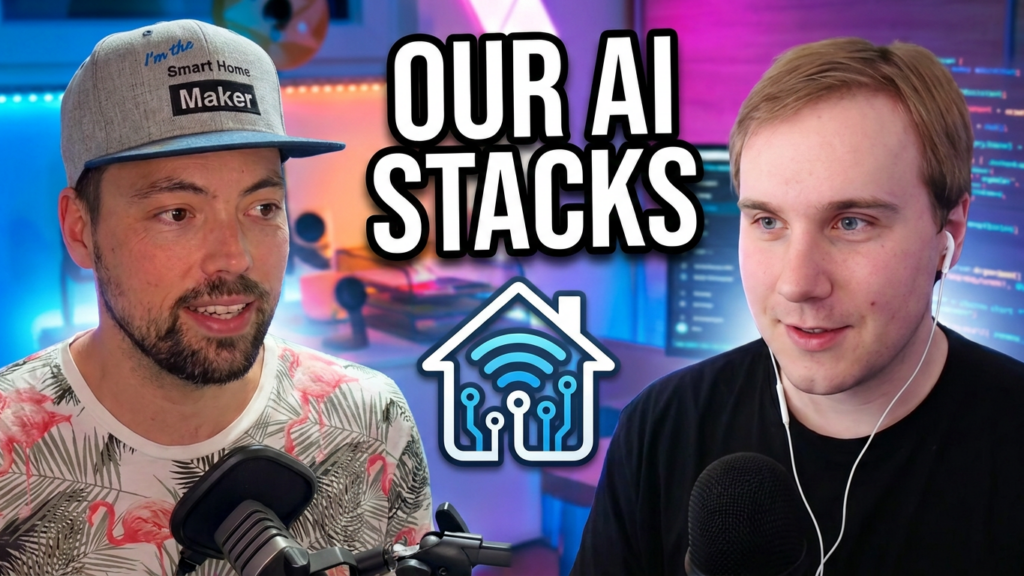
Lukas (hobbyblogging.de) and I have known each other for a while. Two builders, two smart homes, two evenings spent under similar AI rabbit holes. So when we sat down to record episode 28 of the Smart Home Maker Podcast, the question wasn’t whether we use AI in our homes — it’s how, why, and what still confuses us.
Lukas dropped the line I can’t stop thinking about: “AI is a magic box. You put something in, you get something out, and you hope what comes back is right.” That, more than anything, captures where we both are right now. Daily users. Honest skeptics. Still figuring things out.

Why we still need n8n
Lukas opened with the question every developer is asking in 2026: do we still need n8n now that Claude can write code? My short answer in the episode: yes — and not just for sentimental reasons.
n8n gives you something a chatbot can’t: a workflow you can see. Branching logic, conditional paths, retries, error handlers — all explicit on a canvas. Claude can build me a Python script that does the same thing, but a month later I have a code blob I need to re-understand. With n8n I open the workflow and the logic is right there. Control plus visibility. LLMs sit inside individual nodes where they help most.
The magic box — and why we both still trust it
Lukas’ magic-box image is honest. We genuinely do not know what’s happening inside most of our LLM calls. We get an output, we sanity-check it, we ship. The trust isn’t blind — it comes from repetition. After a few hundred runs you know which prompts behave and which need a guardrail.
What I added in the episode: I split my AI work into two layers. The DevOps layer is where I prompt Claude Code, ask it to generate code, refactor workflows, debug. I steer everything I send. The operational layer is where AI runs autonomously inside my home — email analysis, classification, summarisation — and that’s where I anonymise everything before it leaves the house. Different threat model, different rules.
Lukas’ honest confession
Lukas admitted on tape that he hasn’t built the same anonymisation discipline yet. He called himself “an adult on a playground” — moving fast, breaking things, feeling like a small Superman. I think he speaks for a lot of people. The stack moves so fast that doing it “properly” feels like getting left behind. The compromise we landed on: at minimum, know what categories of data you push out, and never push raw customer or family information.
Why we’re both leaving the standard dashboard behind
I mentioned in the episode that I’m increasingly running my smart home through my own UI — built on top of Home Assistant’s APIs, but rendered the way I want, with the data I care about, and with chat / agentic interaction baked in from the start. Lukas referenced my earlier post on dashboards and pushed it further: dashboards aren’t disappearing, but the generic dashboard is. Tomorrow’s smart home interfaces will be deeply personal, AI-mediated, and shaped around how each of us actually lives.
What AI won’t replace
The line we both kept returning to: personal craft. Lukas writes alt-texts for his blog images with AI now — and explicitly says he doesn’t mind, because alt-texts don’t carry his voice. But the article itself, the opinion, the experience — that’s still his. I see the same pattern in my workflows: AI generates the boilerplate, I shape the result. The percentage of “me” in any finished thing didn’t go down. If anything, AI freed up space for more of it.
Listen
The full conversation is in episode #28 of the Smart Home Maker Podcast — out today on the usual feeds, and also as a video above. We’ll definitely have a follow-up. There’s too much that we didn’t get to.
If you’ve been on the same journey — running AI day-to-day in your home and quietly wondering what’s actually in the box — let me know what’s worked and what hasn’t.


Leave a Reply