A reminder when the garage stays open
It happens more often than I would like: the garage door stays open for hours because nobody thought about it again.
Now our house sends me a message on my phone once the door has been open for more than an hour. The message includes a button, so I can close the door straight from the notification.
No app to open, no dashboard to search. One tap and the thing is dealt with.
A turnable housing for the slug detector
Next stage for the slug detector: a housing that can rotate on its own.
The movement comes from a stepper motor, a motor that turns in small defined increments instead of just spinning freely. That is what lets the camera stop at reproducible positions.
With that, one device should be able to cover the whole bed rather than a single corner of it.
Photo on my phone when a slug is found
Third step of the slug project: the detector should not just notice something, it should tell me.
When a slug is recognised, our smart home sends a push message to my phone with the photo attached. So I can see what triggered it instead of trusting a bare alert.
That picture also serves a second purpose. It shows me quickly when the recognition got it wrong, which is exactly what I need at this stage.
Does the raised bed slug detector work
After all the building steps, the honest question remains: does the thing in my raised bed actually find slugs.
So I put it to the test and talk through what it does, where it holds up and where it does not. The recognition side is handled by a trained model, which means the device learned from example images rather than following fixed rules.
I would rather report what really happened than sell a tidy success story. Anyone thinking about something similar in their own garden gets more out of that.
First step towards outdoor distance sensing
This is where the garage project starts: an ultrasonic sensor that is supposed to survive outdoors.
It measures distance by sending out sound pulses and timing the echo. The goal is to know whether a car is standing in front of the garage.
Indoors that is a straightforward exercise. Outside, weather and mounting turn it into a real project, which is why it took several steps.
Family acceptance decides if it stays
I used to measure smart home projects by how clever they were technically. That turned out to be the wrong yardstick.
What decides whether an automation survives is simple: does the rest of the family get along with it. If something has to be explained twice, it is not finished.
Since I look at it that way, I build fewer things, but the ones I build actually stay switched on.
NFC tag against a double dose
Giving medicine to a child and then not being sure whether it already happened is a nasty feeling, especially when two people share the job.
So there is now an NFC tag involved, a small sticker that a phone recognises when held against it. Whoever gives the dose holds their phone to the tag, and the time is recorded.
That way nobody has to rely on memory or shouted questions from another room. One glance answers it.
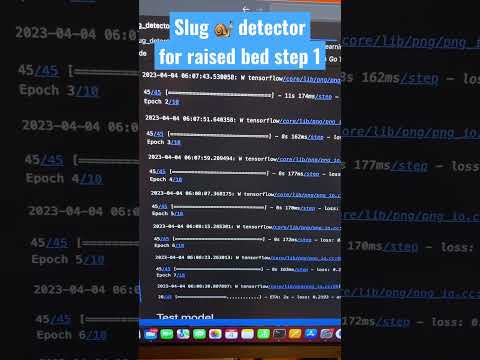
Teaching a model to recognise slugs
For the slug detector to be any use, it first has to learn what a slug looks like.
That means training: I feed the system example images and it works out the pattern itself, instead of me writing rules for shape and colour. Which would be hopeless in a garden bed anyway.
The unglamorous truth is that most of the effort goes into collecting and sorting pictures, not into the clever part.
The self built smart clock is done
The clock I built myself is finally finished and hanging where it belongs.
It went through the usual stages: an idea, a few dead ends, and a longer tail of small corrections that nobody notices in the end.
Store bought would have been quicker. But then it would not do exactly what I wanted it to do.
Sending the house to sleep with one tap
In the evening the same routine used to repeat itself: switch things off, check the doors, get the house quiet.
Now I hold my phone against a small NFC tag, a sticker the phone recognises on contact, and the house moves into its night mode by itself.
It takes about a second and, unlike me, it never forgets a step.
Radio shutters under smart home control
Our shutters came with the house and are operated by a radio remote on 433 MHz, a frequency many simple remote controls use. I wanted them on a schedule instead of on my memory.
To get there I looked at the signals from the original remote with an oscilloscope, a device that draws electrical signals as a curve. A pattern showed up: one part of the signal picks the shutter, the other part says up, down or stop.
With that understood, the shutters now follow sunrise and sunset and can be controlled by voice as well.
Their state also stays in sync, so the house always knows where each shutter is.