The People Who Built AI Can’t Agree On What It Does Next
Sam Altman says AI lifts everyone. Elon Musk builds it at full speed, convinced it takes humanity to the next level. Marc Andreessen literally wrote the words “AI will save the world.”
Then there’s the other camp. Geoffrey Hinton walked away from Google specifically so he could warn us. Yoshua Bengio uses the word extinction. These are not outsiders throwing stones — they built the foundations the optimists are standing on.
Same technology. Same evidence. Opposite conclusions. That’s the part I find genuinely hard, because nobody in this argument is stupid.
Where I land: firmly on the positive side, and not blind about it. I love what this technology makes possible and I use it every day in my own house. But the risks are real, and hand-waving them away is the lazy move. AI is a powerful tool — incredible when you use it deliberately, dangerous the moment you trust it blindly.
So where do you stand? Team Optimist or Team Caution? I genuinely want to know.
Home Assistant got my daughter into the pool
My daughter could already swim. She was just too scared to actually get in the pool.
So I built her a tiny dashboard of her own. Every day she swims, a little hamster on the screen grows one stage further, and she gets closer to a real savings goal she picked out herself. That is the whole system.
I know some people will say you should not reward a child for something like this. Fair enough. But she has been in that pool every single day since, and the fear is gone.
Home Assistant is not only for lights and thermostats. Sometimes it is just a really good reason for a kid to jump in the water.
My smart home kept improving itself while I was away
I am travelling, and the house is not just sitting there idle. My automation system keeps working through its own list of improvements and fixes while I am gone.
Every day I get a short summary of what happened at home: what broke, what got repaired, what is still open. The dashboard in the video is the live view of that — tasks going in on one side, finished work coming out on the other.
The point is not that it is fully autonomous. The point is that I can be a few thousand kilometres away and still know exactly what state my home is in.
A cheap DIY fix for a too-hot home office
My office gets uncomfortably warm on summer afternoons, and a full air-conditioning setup was never going to be worth it for a few weeks a year.
So I went the cheap route instead: a simple fan, a smart plug, and a temperature sensor. Home Assistant switches it on once the room crosses a threshold and off again when it has cooled down. No app, no remote, no thinking about it.
It is not clever technology. It is just the boring kind of automation that quietly removes a small daily annoyance.
My AI agents keep working while I sleep
A while ago I stopped thinking of my home automation as a set of rules and started treating it as a small team. Several AI agents, each with its own job, working through tasks in the background.
They pick up things that need doing around the house and the workshop, work on them overnight, and leave me a summary in the morning. I decide what matters; they handle the grinding.
They run on open-source models on my own hardware, which means the work stays here rather than being shipped off to somebody else’s cloud.
I built a desk gauge for my Claude usage limit
I kept blowing past my weekly Claude usage limit — always mid-task, always by surprise. So I built myself a gauge I can’t ignore.
A small script on my dev machine reads my live Claude usage and pushes it into Home Assistant. From there, Home Assistant fans it out — including to this LED matrix (Ulanzi/Awtrix) on my desk. At a glance I see how much of the weekly limit is gone and a “pace” indicator that warns me if I’m burning through it too fast to last the week.
Home Assistant as the hub, the matrix as the dashboard. No more nasty surprises.
A QR code on every bin tells me what is inside
My workshop went from complete chaos to something I can actually navigate, and the trick is almost boringly simple: every bin has a QR code on it.
Scan it with your phone and you immediately see what is in that bin — name, photo, quantity, category. I can also check a part out temporarily when I borrow it for a project, so I know where it went.
The bins themselves are dumb plastic boxes. The organisation lives entirely in the system behind the code.
An NYU Finance Professor Says This AI Crash Will Hurt More Than Dot-Com
NYU finance professor Aswath Damodaran just dropped a sober warning: the next AI crash could hit harder than the dot-com bust — because this time, the infrastructure spend is debt-financed.
His three uncomfortable points:
- It’s not pure software anymore. Every AI query costs compute. Margins stay thin, scale doesn’t bail you out.
- Deepseek is squeezing prices. Chinese competitors pressure margins further. Growth at bad margins can destroy value.
- Apple’s restraint looks smart. Standing back while others burn billions on hardware that may be obsolete in five years.
Full article (German): the-decoder.de
Custom 3D-printed adapters for every tool on the wall
A 3D printer doesn’t just make toys and brackets. It quietly turns your workshop into something that actually makes sense.
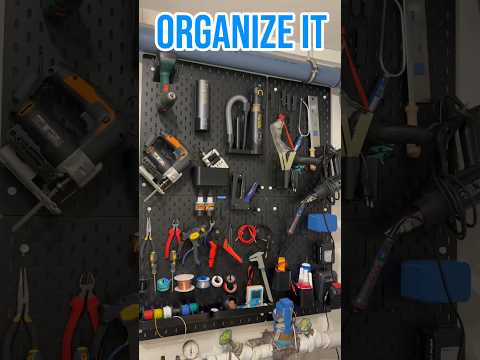
Many tools on my wall have their own custom-printed adapter — sized for the exact handle, the exact head, the exact angle. No more generic peg hooks holding things at weird angles. No more “where did I put that”.
And the best part: I didn’t design any of them myself. Just downloaded the models from Maker World, sent them to the printer, done.
My garage camera makes sure I never forget bin day
I’m not built for routine. Bin day always sneaks up — and once the truck rolls past, you’re stuck with a full bio bin for another two weeks.
So I taught the garage camera to do the remembering. The evening before pickup, it grabs a snapshot, runs it through GPT-4o vision asking “which of the four bins are visible inside?”, then cross-references with the trash pickup calendar. If today’s pickup bin is still inside, Telegram fires off the actual photo — not just a text alert. Photo proof so I can’t gaslight myself.
Setup:
- Reolink garage cam (24/7 RTSP feed)
- GPT-4o vision call with the snapshot
- Waste collection schedule integration in Home Assistant
- Telegram bot with photo attachment
Two weeks in, zero missed pickups. One genuinely satisfying “told you so” from the smart home each pickup evening.
Full write-up with code & setup: how-i-taught-my-garage-camera-to-remember-bin-day
AI Engineering Discipline — Charity Majors
Charity Majors just published the clearest take I’ve seen on what AI actually changes for software engineering.
Her thesis is the opposite of most takes: code production became cheap, but engineering discipline didn’t disappear. It moved upstream. Specs, validation, observability matter more now, not less.
The line that names the whole mental model: “Code stops being an asset and starts acting as a cache: a materialized view of understanding, useful while current, disposable when stale.”
My Bambu Lab AMS 2 Pro Broke — Here’s the Tiny Part That Fixed It
A few days into running my Bambu Lab X2D and the AMS 2 Pro suddenly stopped pulling filament. Disappointing — the printer itself had been excellent up to that point.
I contacted Bambu Lab support, sent videos and notes about what was happening. Their response: “we’ll send a replacement hub.” I pictured a brand-new unit on the way.
When the package arrived, it was a single tiny spare part. Not a hub, not a unit — just a small component.
Owning a 3D printer means being able to repair it yourself. I disassembled the AMS 2 Pro down to the section where this part sits, swapped it, and the unit is running again. Hopefully this repair lasts.
Watch the 90-second story:
Anyone else dealt with AMS 2 Pro filament-feeding issues? Drop your experience in the comments — curious how widespread this is.
— Daniel, The Smart Home Maker
One button to send any thought to my AI assistant
The iPhone Action Button is the most under-used hardware on the phone. I rebound it to do exactly one thing: press → speak → release → my AI captures and routes whatever I just said.
The flow:
- An iOS Shortcut records audio and posts it to my n8n workflow
- Apple’s on-device dictation handles transcription — works even offline
- An LLM classifies what I said (smart-home / work / idea)
- Smart-home stuff becomes a task in Nova (my task system)
- Work stuff is sent to my work inbox
- Random ideas drop into my notebook
- Telegram pings me with the result in about 2 seconds
What this kills: the friction between having a thought and actually capturing it properly. No app to open, no typing, no category-picking. Great for joggers, drivers, parents — anyone whose hands are busy and brain is on.
I Replaced the Spider-Web Display on My Wife’s Pixel 7a
My wife’s Pixel 7a hit the floor. The screen turned into a spider web overnight — still functional, but barely usable in the sun and a glass-shard hazard waiting to happen.
Instead of sending it in, I ordered the replacement assembly, popped the back panel, swapped the OLED, reconnected the fingerprint flex, and reseated the battery in about an hour.
Bricked phone risk: real. Cost vs. a repair shop: a third. Satisfaction of handing it back working: unbeatable.
How My House Prepares for My Return from Vacation
My house starts heating before I even tell it I’m coming home.
100 km out, a proximity sensor reads my phone’s GPS — the heating leaves vacation mode and slowly ramps the house back to normal. 5 km out, the boiler goes to full temp. By the time I unlock the door, the alarm has disarmed itself.
No app opened. No buttons pressed. Just Home Assistant noticing.
In the Short I walk through the full setup.
Every Evening at 8, My House Texts Me
Every evening at 8, my house sends me a text. Today’s energy use, solar production, alarm status, whether anything weird happened. I’m on vacation — the briefing follows me wherever I go.
Only rule: tell me what matters. Anomaly → ping. Quiet day → still a short check-in so I know the silence is real.
Smart Locks Earn Their Keep On Days You’re Not Even Home
On vacation, yearly heating maintenance was due. Old me would have cancelled. Instead I generated a temporary access code on my phone — technician let himself in, did the job, code auto-expired afterwards.
Smart locks earn their keep on the days you’re not even there.
A Joystick Transplant Saved My Kids’ RC Monster Truck
A joystick transplant saved my kids’ RC monster truck this weekend. Both original sticks snapped off — I spent hours suspecting the wrong patient (the truck itself) before catching it. Then desoldered the dead sticks, wired in a generic 2-axis KY-084, cut its PCB to fit the housing, modded the top cover. Not fast, not pretty. But the truck rolls again.
Our Smart Home Knew We Were Stressed Before We Did
Our smart home knew we were stressed before we did. A 0–100 family stress score blends six sensor signals — living-room mic peaks, motion bursts on the ground floor, time of day, who’s home alone with the kids, plus a weekend modifier — into one number that quietly reshapes the house. When the score climbs over 60, lights warm automatically, music suggestions get softer, notifications get held back.
Today the score ran exactly the curve you’d expect: calm morning, red zone in the late afternoon, back to quiet after bedtime. Watch the 50-second walkthrough for the full breakdown.